Case study
Called to Heal Counseling
A Eugene counselor going out on his own, public the day after the Friday text thread. Fourteen pages in his voice, a direct booking link, faith offered and never pressed, and a build that keeps health information off the website entirely.
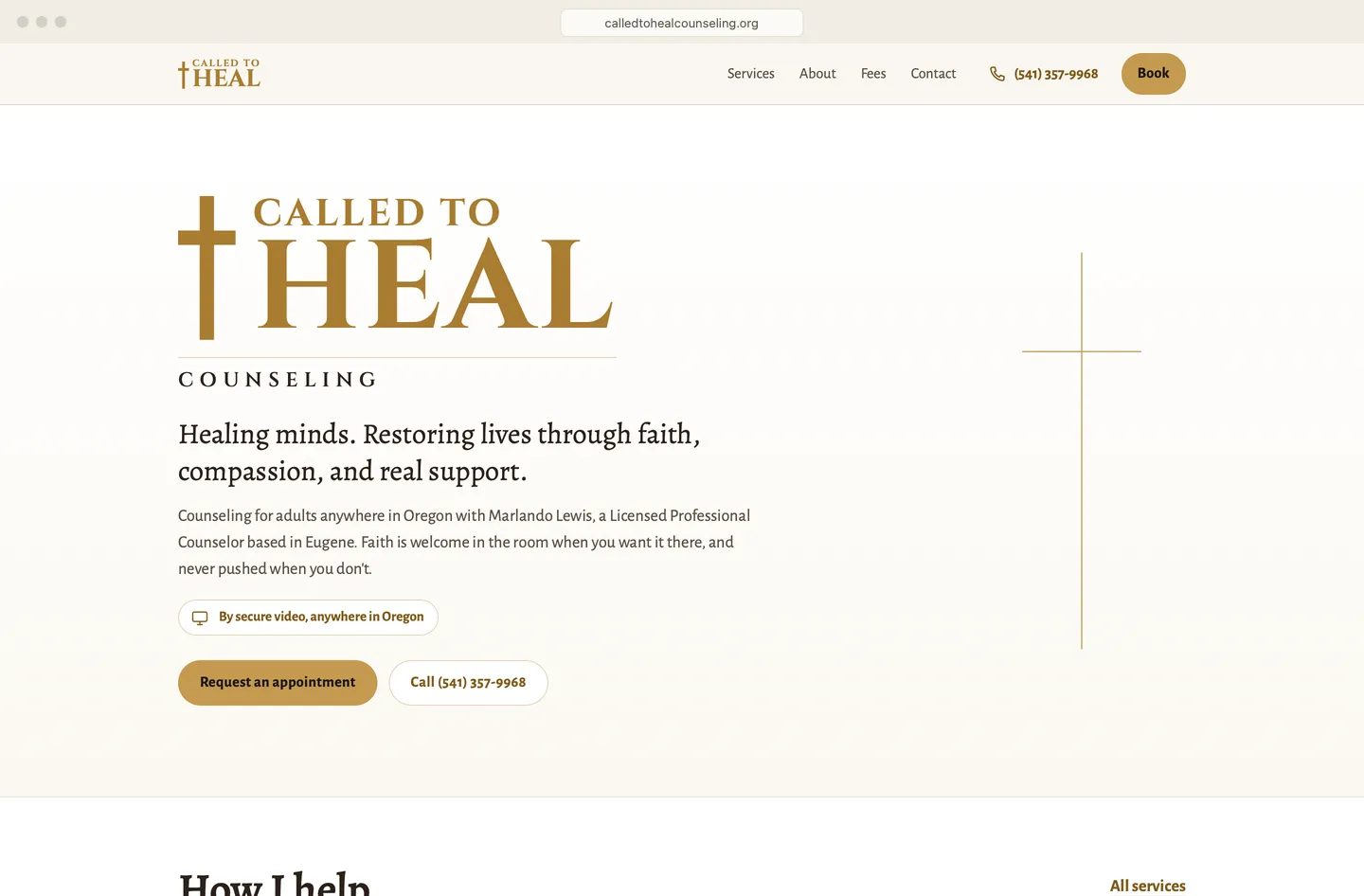
Marlando Lewis is a Licensed Professional Counselor in Eugene, Oregon, going out on his own as Called to Heal Counseling. He brought a headshot, a flyer, and a clear picture of the people he wants to sit with: adults carrying anxiety, trauma, loss, a strained marriage, and for some of them a faith they want in the room. The site opens on his promise, "Healing minds. Restoring lives through faith, compassion, and real support."
The conversation started on a Friday, by text. By Saturday afternoon the site was public: fourteen pages on his own domain and his own hosting account, running a fork of UlricCMS he can edit in place. Between those two points sat four deploys. Each was built locally, deployed, and checked again on the live server, and the two that carried new pages went through an adversarial review first, the kind that hunts for problems before a client ever sees them.
Counseling sites carry rules most sites never think about, and this build was held to them from the start: no testimonials, no client stories, and no form anywhere that could collect health information. The contact page offers a phone number, an email address, and a direct link to book through his SimplePractice portal, which is where client records belong. The 988 line is in the footer of every page and again on the contact page, next to 911. Faith gets the same care. The copy offers it and never presses it: "Faith is welcome in the room when you want it there, and never pushed when you don't."
Each of the six services has its own page, written in his register rather than a template's. Two panels on the home page run on a clock, one through the services and one through the steps of getting started, with a pause button and a still version for anyone who has reduced motion switched on. On the About page, fourteen of his own photographs sit in a stack of polaroids, captioned in his voice. Search markup went in with the first pages: service markup on every service page and a 23-question FAQ that answer engines can read. His Psychology Today profile was rewritten the same evening so the two sound like the same person.
Marlando's practice is what I build for therapists starting a solo practice.


Common questions
How fast can a therapist's site go live?
Called to Heal went from a Friday text thread to a public site on Saturday afternoon. The engine made that possible: UlricCMS already carries the pages, the markup, and the deploy tooling, so the day went into his words and his photographs.
Why is there no contact form?
A contact form invites people to describe what they are going through, and that is health information sitting on a web server. Called to Heal points every inquiry to a phone call, an email, or his SimplePractice portal instead.
Can a faith-informed practice avoid sounding preachy?
Faith has its own service page, and the terms are stated plainly on it: scripture and prayer come in only if the client asks for them. Everywhere else the copy simply says faith is welcome.
Does he own the site?
Yes. The domain, the hosting account, and the booking account are all in his name, and every page edits in place under his own login.