Insights
One button, no reading, no login: designing panic.btn
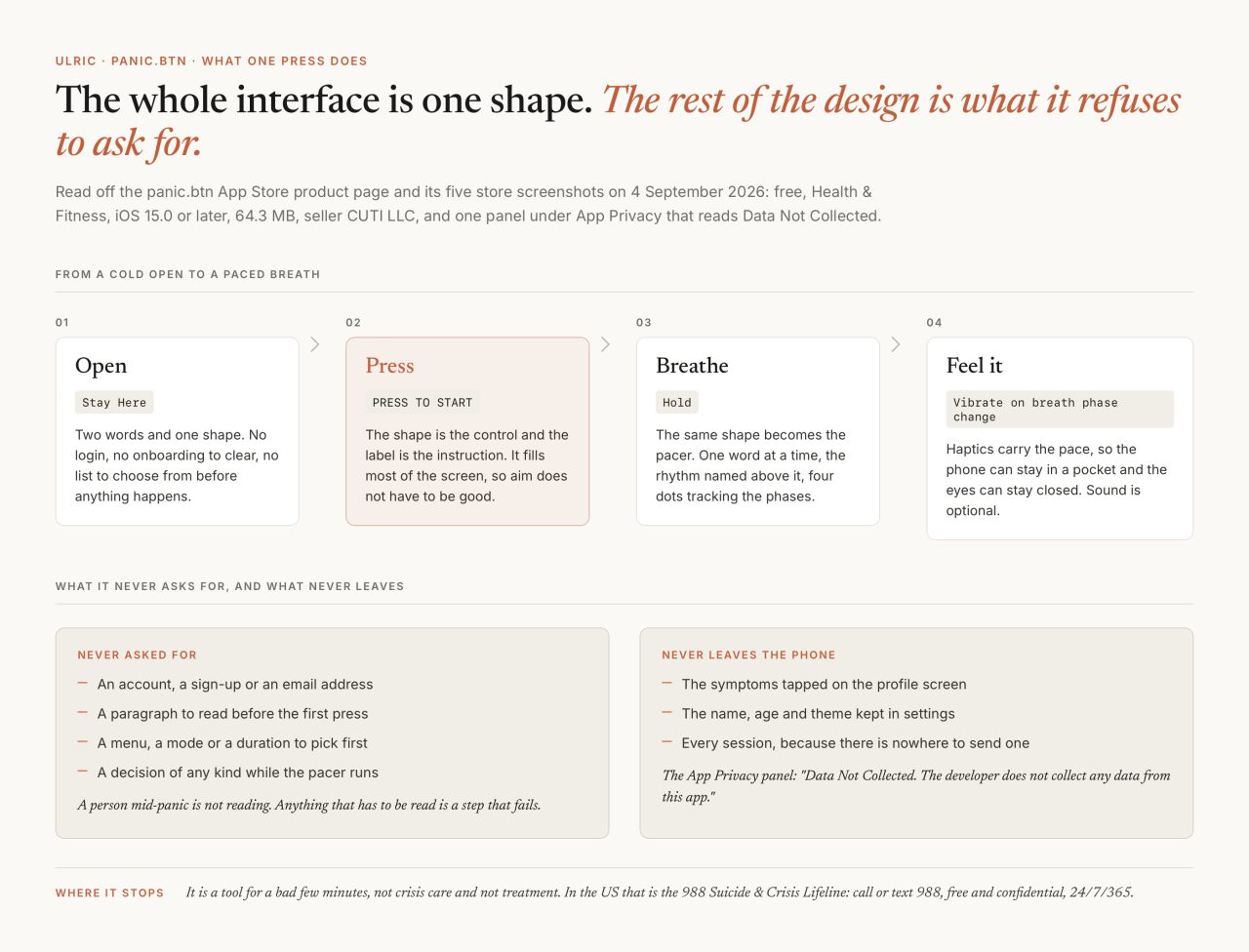
panic.btn opens on two words and one shape. Stay Here, and underneath it a soft blob filling most of the screen that says PRESS TO START. That is the whole first screen: whatever an app usually wants before it starts working, this one skips. It is free on the App Store, it downloads at 64.3 MB, and the panel near the bottom of its product page reads Data Not Collected. Almost everything interesting in the design is a subtraction.
What is panic.btn?
It is a free iPhone app that paces your breathing, built to be usable by somebody who is in no state to use anything. Apple's lookup endpoint, checked on September 4, 2026, returns the frame around it: seller CUTI LLC, category Health & Fitness, first released January 15, 2026, currently at version 3.6.2 from January 28, 2026, and a minimum of iOS 15.0. The subtitle on the page is "Instant Somatic Anxiety Relief". The case study on my own site puts it in one line I still stand behind: it is the app I wished my clients had between sessions.
Said plainly, before anything else: panic.btn is a self-help tool for a bad few minutes, not crisis care and not treatment. In the United States, crisis care is the 988 Suicide & Crisis Lifeline. You can call or text 988, or chat at 988lifeline.org, and in the Lifeline's own words, "The 988 Lifeline is available 24/7/365. Your conversations are free and confidential."
Two ratings, both five stars. I am not going to dress that up: two ratings is not evidence of anything, and there is no install figure here worth publishing. What the app is good for is a design argument, which is why it gets a post rather than a launch announcement. It is one of five apps under the same seller line, and three of the others are covered in a separate post on three small iOS apps. This one is about a single screen.
Why one button, and why no reading?
Because reading is the first thing to go, and because the window is short.
The National Institute of Mental Health describes a panic attack as "a sudden wave of fear or discomfort or a sense of losing control even when there is no clear danger or trigger", and puts the duration plainly: "A panic attack can last from a few minutes to an hour or sometimes longer." Its symptom list is the part that matters for interface work. "Pounding or racing heart, Sweating, Chills, Trembling, Difficulty breathing, Weakness or dizziness, Tingly or numb hands, Chest pain, Stomach pain or nausea."
Read that as a spec and the constraints fall out on their own. Trembling hands means the target has to be enormous and forgiving, because aim is gone. Difficulty breathing means the person is already losing the thing the app is about to ask them to do. Racing heart and a sense of losing control mean working memory is spent, and a screen that asks somebody to pick between six modes is asking them to spend what they do not have. Every screen I build is designed for somebody at partial attention, which is the whole argument in designing mobile-first for one thumb. This is that argument at its limit: not partial attention, no attention.
So the first screen holds one control, and the control is the instruction. PRESS TO START is not a label next to a button. It is the text inside the only thing on the screen you can press.
What happens when you press it?
The same shape becomes the pacer, and one word at a time tells you what to do with your lungs.

In the second store screenshot the rhythm is named quietly at the top, BOX BREATHING, under the section name THE ANCHOR. The middle of the shape carries a single word, Hold, with a short italic line beneath it: Stay present. Four dots track the phases of the cycle. A line of small caps above says LET THE EARTH HOLD YOUR WEIGHT. At the bottom sits an atmosphere player, set to Theta Waves in the shot, which is optional and can be left alone.
Underneath that is the part I care most about. In the app's settings there is a toggle called Haptic Feedback, with one line of explanation: VIBRATE ON BREATH PHASE CHANGE. The most recent release notes, for version 3.6.2 on January 28, 2026, name it as the headline change: "Enhanced Haptic Breathing: We've refined the vibration patterns to better guide your 'Physiological Sigh' even when your phone is in your pocket."
That sentence is the accessibility feature that actually matters here. If the pace arrives as vibration, the screen becomes optional. You can close your eyes. You can keep the phone in a pocket in a meeting, on a bus, in a supermarket aisle, and follow it without looking at anything. A visual pacer requires you to watch a phone during the least dignified two minutes of your week. A haptic one does not.
Behind the button is a library of rhythms, and the app names them with their counts rather than with moods. The description lists "4-7-8, Box Breathing, and Vagus Nerve resets", and the store screenshot of that list shows the first entry as Vagus Nerve (4-8) with its own instruction underneath: FOCUS ON EXTENDED EXHALE TO SIGNAL SAFETY. Most of the entries below it carry a small padlock, which is where the paid tier lives.
Where did a counselor's knowledge change the interaction?
In three places: the words on the symptom chips, the register of the copy, and the scope of what the app agrees to be.

Look at the profile screen in that third store screenshot. Along the bottom, five of the six chips read: CHEST TIGHTNESS, RACING HEART, DIZZINESS, SHORTNESS OF BREATH, TREMBLING. Now read the NIMH list again. They are close to the same list, in close to the same words, and that is not a coincidence or a research exercise. Those are the words people use when they describe it out loud in a room, and I spent years in rooms where they said them. Before I built full-time I ran a private practice in trauma, addiction and serious mental illness, worked residential treatment before that, and I still do high-risk assessments in a county jail. Where the rest of that judgment comes from is its own post.
The alternative design, the one a lot of wellness apps ship, is a mood slider from one to ten. A slider is easier to store and easier to chart, and it asks a person mid-panic to perform an act of abstraction. Tapping the words for what your body is doing is a much smaller ask, and it is the same ask a clinician makes in the first minute of the session.
The second place it shows is the register of the copy. LET THE EARTH HOLD YOUR WEIGHT is a grounding instruction, not a slogan. Stay present, sitting under a single word, is what a therapist says when somebody starts narrating the panic instead of breathing through it. The instruction is one word because instruction under that much arousal has to be one word.
And the third is scope. The app is built for the gap between appointments, for somebody who has a plan and cannot reach it in the moment. It does not try to be the appointment.
What does the app deliberately not do?
It does not keep anything, and it does not try to be a clinician.

The panel says it in Apple's words rather than mine: "Data Not Collected. The developer does not collect any data from this app." The promotional text on the same page says the user-facing half of it, "No ads. No accounts. Just relief", and one of the store screenshots is nothing but the sentence 100% Private. No Account Required. The symptoms someone taps, the name and age in settings, the theme they chose: all of it stays on the phone. There is no server to send it to, which means there is nothing to breach and nothing for anyone to come and ask me for later.
The harder subtraction is clinical. The app does not score anyone, does not name a condition, does not decide whether this is a panic attack or something that needs an emergency room, and does not route anybody anywhere. That is partly a design choice and partly a rule I would be held to anyway. Apple's App Review Guidelines are explicit about the category:
Medical apps that could provide inaccurate data or information, or that could be used for diagnosing or treating patients may be reviewed with greater scrutiny.
The same guideline adds that apps "should remind users to check with a doctor in addition to using the app and before making medical decisions". A breath pacer that stayed a breath pacer never has to test how far that scrutiny goes, and I have written elsewhere about what App Review does ask a small studio for.
How strong is the evidence, and where does it stop?
There is a real randomized trial behind the breathing, and it did not study anything as acute as a panic attack.
The paper is Balban and colleagues, "Brief structured respiration practices enhance mood and reduce physiological arousal", in Cell Reports Medicine in January 2023. It is the study that put cyclic sighing in front of a general audience, and it is worth quoting its own summary rather than a blog restating it:
Using a mixed-effects model, we show that breathwork, especially the exhale-focused cyclic sighing, produces greater improvement in mood (p < 0.05) and reduction in respiratory rate (p < 0.05) compared with mindfulness meditation. Daily 5-min cyclic sighing has promise as an effective stress management exercise.
Read the design next to the claim. 108 participants, daily five-minute exercises over one month, with box breathing as one of the compared arms, and endpoints of mood, anxiety, respiratory rate, heart rate and heart rate variability. The authors name their own limits: "The remote nature of the study limited the monitoring of how closely participants followed the instructions", and "the findings of this study are limited to 4 weeks with no additional follow up".
So the honest boundary is this. There is decent evidence that a daily exhale-focused breathing practice moves mood and respiratory rate over a month. There is no measurement in that paper, or in anything else I have found, of a phone app aborting a panic attack in seconds. The subtitle on my own listing says "Instant Somatic Anxiety Relief", and nothing in the trial supports the first word of it. The rhythms in panic.btn are real practices with a real literature. The app's job is to deliver one of them to somebody who cannot look up a technique right now, which is a smaller claim than the subtitle makes, and the one I can defend.

What generalizes past this app is a habit I have had for code and never had for a listing. I audit my own diffs adversarially before they ship, and I had never once audited the product page the same way, even though the store listing is the only part of the product most people ever read. It has a privacy declaration, a claim about efficacy in its own subtitle, a pricing table and five images, and every one of those is a promise made to a stranger under Apple's rules. Read it as a stranger, once, with the primary sources open next to it. It takes twenty minutes.
One thing here is not fixable, and I have made my peace with it. Because nothing is collected, I cannot see whether anybody presses the button twice. The single number I would most like to know, whether the thing works well enough that a person comes back to it in their next bad minute, is the number the design guarantees I will never have. The only signal that ever reaches me is somebody telling me directly, which is a slow and biased instrument, and it is the one I chose when I filled in that privacy form.
Common questions
Is panic.btn crisis care?
No. It is a self-help breathing and grounding tool for a bad few minutes, and it does not diagnose, score or triage anybody. In the United States, crisis care is the 988 Suicide & Crisis Lifeline: call or text 988, or chat at 988lifeline.org. In the Lifeline's own words, it is available 24/7/365 and conversations are free and confidential.
What does panic.btn cost, and what does it collect?
It is free to download, with in-app purchases: the product page lists Monthly Pro Access at $0.99, Yearly Premium Access at $4.99 and panic.btn Pro Lifetime Access at $9.99, checked on September 4, 2026. Its App Privacy panel reads "Data Not Collected. The developer does not collect any data from this app." There is no account and no sign-up.
What actually happens when you press the button?
The shape you pressed becomes the breathing pacer. The rhythm is named above it, a single word inside it tells you which phase you are in, four dots track the cycle, and a haptic pulse marks each phase change so the pace can be followed without looking at the screen. An optional atmosphere track plays underneath. Nothing else has to be decided.
Is there evidence behind the breathing exercises?
For the practices, yes, within limits. Balban and colleagues, writing in Cell Reports Medicine in January 2023, ran a randomized trial of daily five-minute breathwork in 108 participants and found exhale-focused cyclic sighing improved mood and reduced respiratory rate more than mindfulness meditation over a month. That is not a measurement of an app stopping a panic attack in seconds, and I would not present it as one.
Related