Insights
iLovable: a box of therapy tools that stays on the phone
iLovable is a box of six therapy tools in one iPhone app that downloads at 13.5 MB. I built it after ten years of handing people the paper versions across a counseling room. What follows is how a room exercise becomes a screen, and where the tool stops and a claim would start.
What is a part, once it is on a screen?
A card with a name, a role, and one line the person wrote themselves.
Internal Family Systems is a therapeutic model developed by Richard Schwartz, and the IFS Institute's own outline of it opens with an assumption that reads like an interface specification:
It is the nature of the mind to be subdivided into an indeterminate number of subpersonalities or parts.
Indeterminate is the load-bearing word. It rules out a fixed set of slots, a five-step wizard, and any screen that asks somebody to pick their parts from a list I wrote. A map has to be something you add to, name yourself, and move around. The same outline hands the screen two more constraints without meaning to. Parts, it says, "may be experienced in any number of ways", listing thoughts, feelings, sensations and images, so the field where you describe one is free text rather than a menu of feelings I picked. And then the assumption that decides the visual design:
There are no "bad" parts, and the goal of therapy is not to eliminate parts but instead to help them find their non-extreme roles.
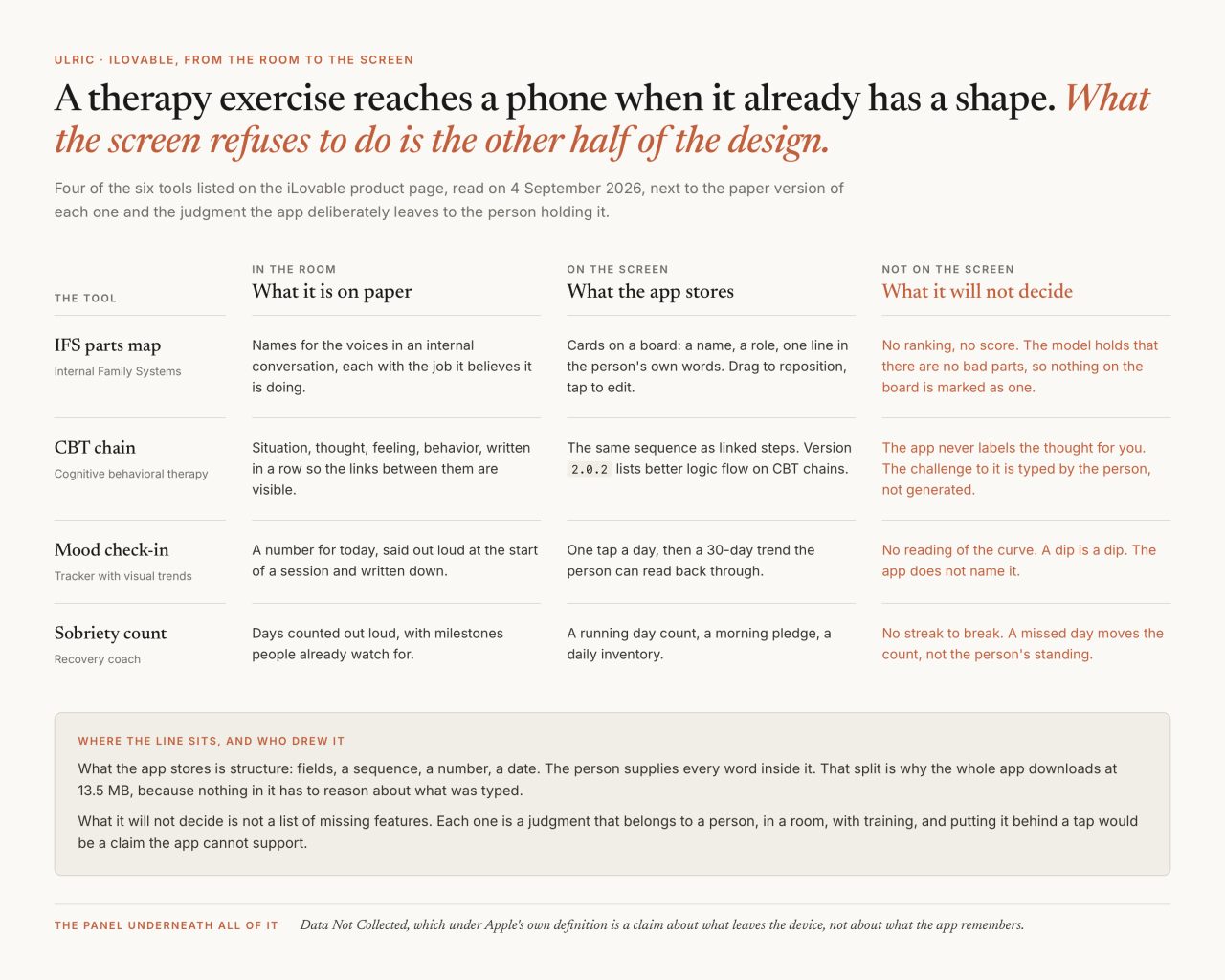
So nothing on the board is scored, ranked, flagged, or colored to mean worse. A part is a card: a name, the role it plays, and a line in the person's own words about the job it thinks it is doing. You drag it where it belongs and tap it to edit. That is the entire model of the screen, and a board you can rearrange with one thumb on a bus matters more here than a clever layout, which is the general case I made for designing for one thumb first.

Worth naming before it gets assumed: the app is informed by the model, not endorsed by anyone. The IFS Institute has been the sole provider of training and certification in Internal Family Systems for decades, and iLovable is not affiliated with it. I work in IFS as a licensed counselor, which is where I know the exercise from, and that is the whole extent of the claim.
Three of the other five tools crossed over the same way, and each one arrived with its own list of things the screen had to decline to do.

Why is it 13.5 MB when Mutterly is 813.4 MB?
Because Mutterly carries a language model inside its download and iLovable does not. I walked that difference through byte by byte in the post about the three small apps.
An app with no model in it also has nothing worth sending anywhere, which is where the next promise comes from. iLovable's own build, tool by tool, is a case study on this site.
What does "Data Not Collected" actually promise?
That nothing goes to me. Apple's definition is narrower, and more useful, than the phrase sounds:
"Collect" refers to transmitting data off the device in a way that allows you and/or your third-party partners to access it for a period longer than what is necessary to service the transmitted request in real time.
The panel is a claim about the network, then, not about the app's memory. iLovable keeps a great deal: entries, dates, a running count, a board of cards. None of it moves. The store description says the same thing in one line, "All your data stays on your device. No cloud sync, no accounts required", and the panel on the product page attributes the whole declaration to a person rather than to Apple: "The developer, Franz Richers, indicated that the app's privacy practices may include handling of data as described below."

That makes the label an architecture decision rather than a legal one. The cheapest way to keep it true is to have nothing to send: no account, no login, no sync, no analytics SDK, no crash reporter carrying anything a person wrote. Every one of those is a component I did not add, and a component I do not have to keep honest later.
It costs me the instrument every other product has. The dashboard in the gallery counts a person's entries for them, 19 in the demo, and it counts nothing for me. I do not know which of the six tools gets opened on a Tuesday night, whether anybody finishes a CBT chain, or how many cards a real parts map has on it. One rating and whatever somebody chooses to write to me is the entire feedback loop. I would make the trade again for this app, and it belongs in the ledger as a cost rather than as a virtue.
If nothing leaves the phone, what is the share button?
Something the person drives, which is a different act from collection.
The store description offers shareable cards for a milestone and puts the boundary in the user's hands: "Share only what you choose with your therapist or support network." Under Apple's definition above, that is not collection, because I am not the one transmitting and there is nothing at my end to receive it. The design work is in making the leaving deliberate: a card somebody picked, sent where they meant to send it, rather than a bulk export of a journal. Once it is in a text thread it is out of the app's hands and out of mine, which is worth saying plainly to anybody about to send a screenshot of their parts map to a group chat.
What the store copy claims, and what I will not add here
The product page is where the app is sold, and it makes product claims. The description calls the tools "evidence-based" and says the app was "designed by mental health professionals". The first is a claim about the methods: CBT, IFS and a daily inventory each have their own literature and their own training pathway, which is why the exercises exist at all. The second is a claim about who wrote it, and it is checkable. I hold an Oregon LPC license, I ran a private practice from 2019 until I closed it in July 2026, and I still work in a county jail. Where that decade shows up in the rest of my work is a post of its own.
What I will not write, here or anywhere: that iLovable treats, diagnoses or improves anything. No trial stands behind it and there is no outcome data, mine or anybody else's. It is a place to keep the work between sessions, and the sessions are the part with another person in the room.
The category turns that boundary into a rule rather than a preference. iLovable is filed under Medical, and Apple's App Review Guidelines open their section on physical harm with this:
Medical apps that could provide inaccurate data or information, or that could be used for diagnosing or treating patients may be reviewed with greater scrutiny.
The same guideline adds that apps "should remind users to check with a doctor in addition to using the app and before making medical decisions". Read that next to the age rating the store assigns the listing: 13+, with detail rows reading "Infrequent: Medical Treatment information" and "Contains: Health or Wellness Topics". None of it is decoration. It is the store saying, in its own form fields, that this is a shelf where sentences get read carefully. The seller line underneath says CUTI LLC for a related reason, which I got into in the post on shipping native as a web studio.

Re-reading my own listing to write this turned up a line that no longer matches the app. The description still offers "Additional AI therapy sessions available via in-app purchase", while the product page itself lists no in-app purchases at all. The page is what a person actually reads, so the description is the thing that is wrong.
What the page still owes
One row on that page is empty, and it is the wrong one to leave empty.
Directly under the privacy panel, on the listing, the store prints: "The developer has not yet indicated which accessibility features this app supports." That is a form in App Store Connect I have not filled in, on an app in the Medical category whose entire premise is somebody reaching for it on a bad day. Filling it in honestly means auditing what the app actually supports first, Dynamic Type at the largest sizes, VoiceOver labels on a board of draggable cards, contrast in dark mode, which is the useful half of the exercise anyway.
The other thing I owe it is a way to hear back. I do not know how many people have opened the parts map, and by design I never will, so the only instrument left is asking.
Common questions
Is iLovable therapy, or a replacement for it?
Neither. It is a place to keep therapeutic exercises between sessions: a journal, a mood tracker, a CBT chain, an IFS parts map, a fear inventory and a recovery coach. It makes no diagnosis, gives no interpretation, and has no outcome data behind it. The work that needs another person in the room stays there.
Does anything I write in iLovable leave my phone?
Not to me. The App Privacy panel on the product page reads "Data Not Collected", and Apple defines collection as transmitting data off the device in a way the developer can access later. The app has no account and no cloud sync, per its own store description. Anything that leaves does so because you tapped share and chose where to send it.
What does it cost?
It is listed as Free on the App Store, checked on September 4, 2026, and the product page shows no in-app purchases. The description still carries an older line about AI sessions being available as an in-app purchase, which no longer matches the listing.
Is the app affiliated with the IFS Institute?
No. The IFS Institute has been the sole provider of training and certification in Internal Family Systems for decades, and iLovable is not connected to it. Naming the model describes the exercise on the screen, nothing more. I work in IFS as a licensed professional counselor in Oregon, which is where I know the exercise from.
Related