Insights
The harness reads my texts now
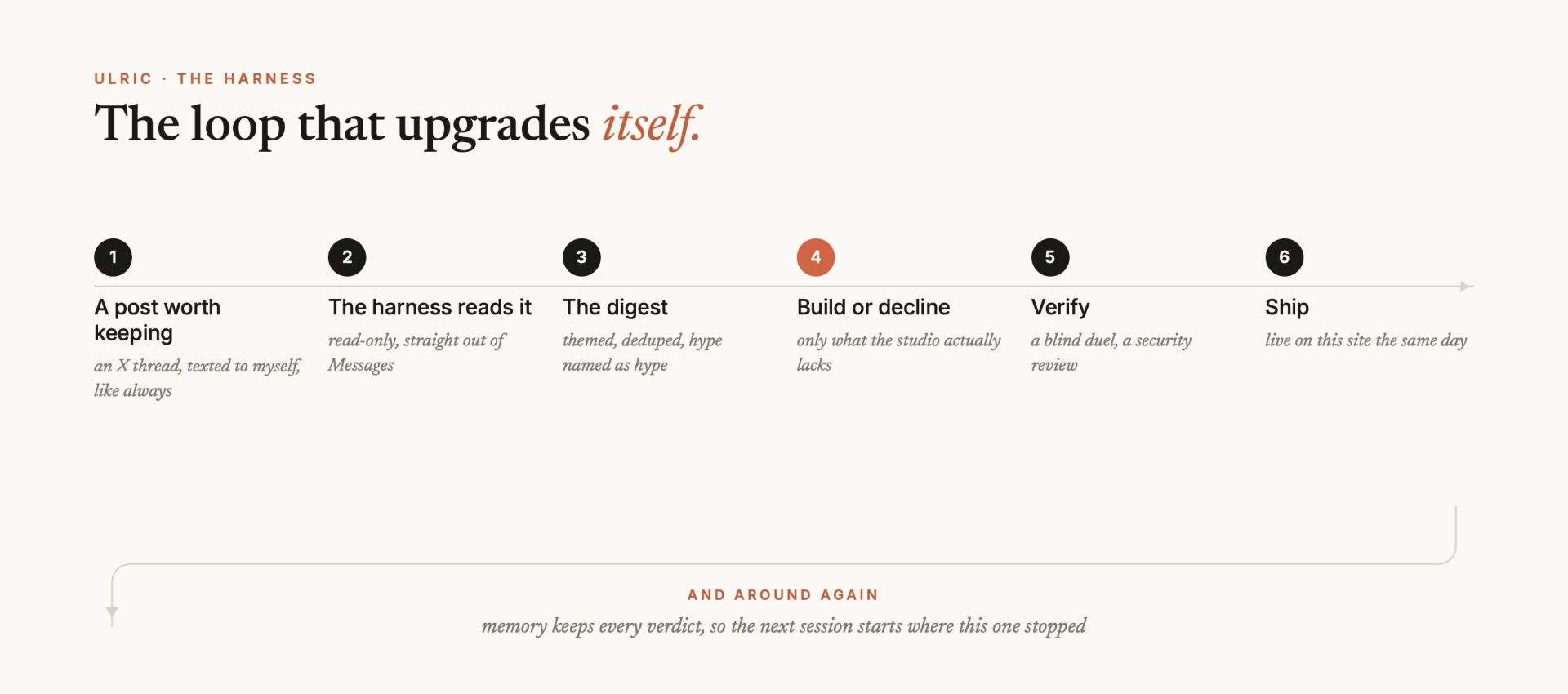
For over a year I have had a habit that will sound familiar: when an X post about agent workflows looks useful, I text it to myself. The thread with my own name on it is a museum of good intentions, 105 posts deep, and until this week I had read almost none of them twice.
This week I gave the studio's harness, the Claude Code setup that builds everything you see on this site, read-only access to that thread. Not an integration, not a product. A local database query and one deliberately granted permission, with a hard rule on top: it can look, it can never touch. Every session now starts with a quiet check: anything new in the pile?
Reading 105 posts so I don't have to
The first pass read 101 of the 105 (the remaining four had been deleted, which is its own review). The honest finding: most of what I saved was noise. Engagement bait about teenagers earning fortunes. "Free forever" tricks that turn out to be credential harvesting in a trench coat, sitting right beside breathless summaries of conference talks that never happened quite the way the thumbnail claims. The digest names the junk as junk and keeps the verdicts in the studio's memory, so it never has to re-litigate a post it already judged.
Four ideas survived scrutiny. Three of them shipped the same day, which is the part of this story I care about, because a reading pipeline that produces reading is a diary, and a reading pipeline that produces working software is a loop.
Upgrade one: the blind duel
One saved post described a pattern I liked immediately: run the same question through two models that cannot see each other, then have a third read both answers and write the final one from where they agree, where they split, and what both missed. One run can be confidently wrong. Two runs, cross-examined, cannot hide it.
The studio version needs no external service. Two agents get the same brief blind, each with a different working stance so their errors do not correlate, and an adjudicator resolves every split with evidence rather than a vote. It costs about three times a single run, so it is reserved for the answers that must not be wrong: the research that shapes a client plan, the architecture fork that is expensive to walk back.
Upgrade two: the assistant learns how things connect
The best one-liner in the whole pile: embeddings know what things mean, graphs know how things connect. The assistant on this site retrieved by meaning alone. Ask it a question and it found the knowledge that resembled the question, which works until the answer lives in a chunk worded nothing like what you asked.
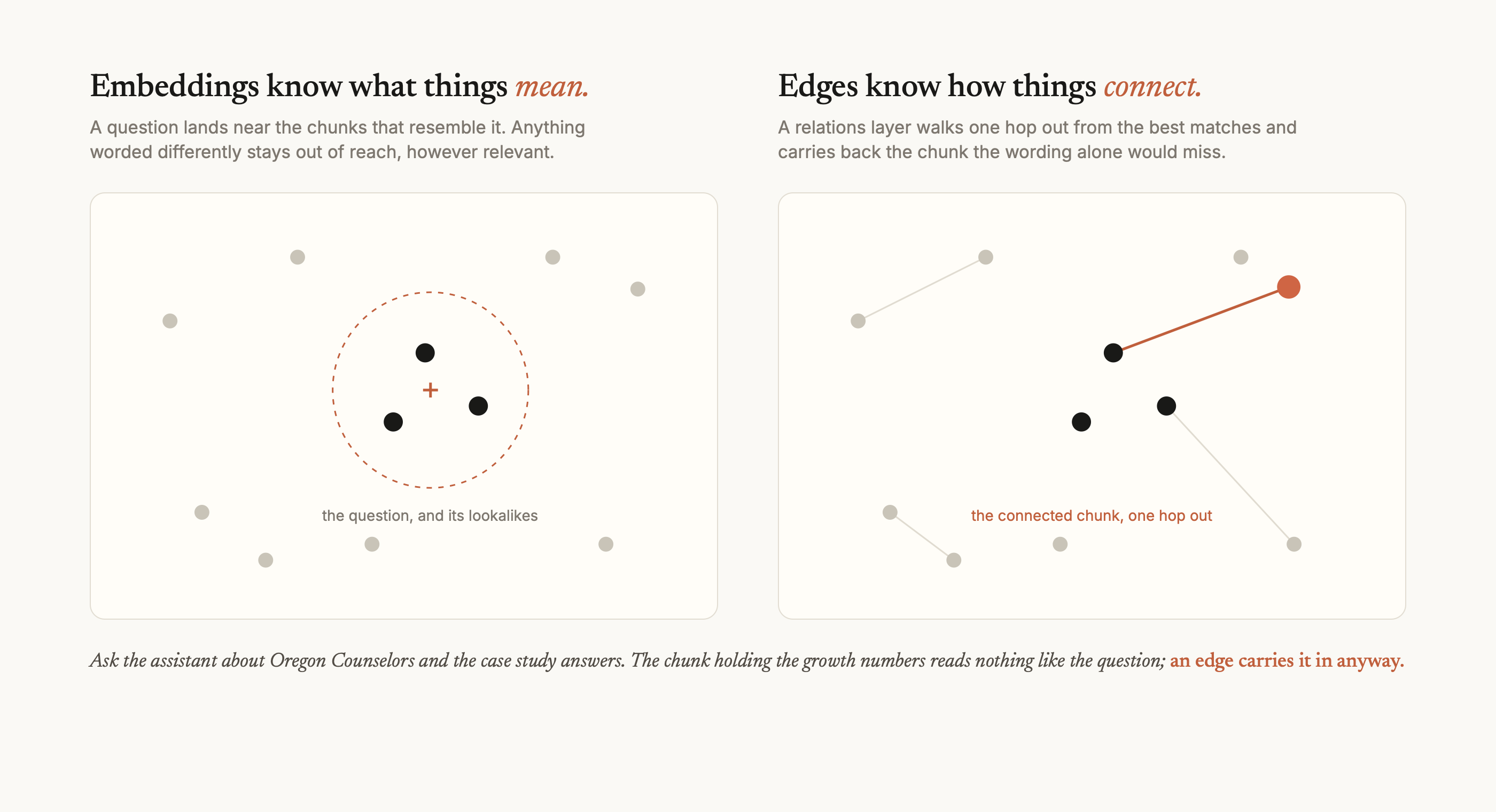
So the knowledge base now carries a relations layer. When one chunk's text mentions another chunk by name, they are linked. When two chunks share a genuinely rare tag, they are linked. Retrieval finds its lookalikes the way it always has, then walks one hop out along the edges and brings back up to two connected chunks. The edges rebuild themselves whenever the knowledge is edited, and the retrieval explorer in my dashboard labels exactly which chunk arrived by which route, because a system I cannot inspect is a system I cannot trust.
It is live now. Ask the assistant in the corner about Oregon Counselors and the chunk holding the growth numbers rides in on an edge, not on resemblance.
Upgrade three: a smaller rulebook
The third idea was less flattering: a reminder that every standing instruction an agent carries is a tax paid on every single session, before any work begins. My global rulebook had grown to 358 lines because every hard-won lesson became a law, and laws accumulate.
It is 200 lines now. The rules that apply to every session stayed. The conditional ones, what to do when code touches email, how LLM fallback chains must be built, the whole mobile-first doctrine, moved into skills that load themselves only when their trigger appears. Same laws, same teeth, half the standing weight. Anthropic's own guidance says a rulebook past 200 lines stops being read carefully, and that is as true of models as it is of people.
What got declined matters as much
The loop also said no. A memory plugin got declined because the studio already does that job better, and so did two large skill packs once I checked their useful pieces against tools already on the shelf, along with a genuinely impressive pattern for running three hundred agents at once, which is a capability a one-person studio would wear like a borrowed coat. Each verdict is recorded with its reasoning, which means the next time one of those ideas arrives wearing a different thumbnail, the harness already knows the shape of it.
This is the same discipline I sell to clients as business loops: a scoreboard the agent can check unattended, one reversible step per cycle, a human gate on anything that faces outward. The only difference is that this loop's scoreboard is my own workflow, and the product it improves is the thing that builds everything else.
Related