Insights
Setting up an AI agent for a realtor who was out of hours
The request that started this was not "automate my business." It was closer to a confession: a realtor with a full pipeline, a CRM she trusted, and no hours left in the week. She did not need more leads. She needed the reading, the sorting and the first drafts of things to stop landing on her alone.
Watch first, build second
Before touching anything I spent a day beside her while she worked. Not interviewing her: watching. Which tabs stayed open, where a lead actually goes after the phone call, what she retypes for the fourth time that week, which emails she agonizes over and which she fires off without thinking.
The day produced a short list with two columns. Column one: work that repeats and follows rules she could state out loud. Checking who has gone quiet in the pipeline, assembling market numbers for a listing appointment, the logistics emails around showings and inspections. Column two: work that is entirely judgment. Pricing conversations, negotiation, anything a client will read as her. The build only ever touches column one, and that decision, made before any software existed, is why the rest of it worked.
What a harness actually is
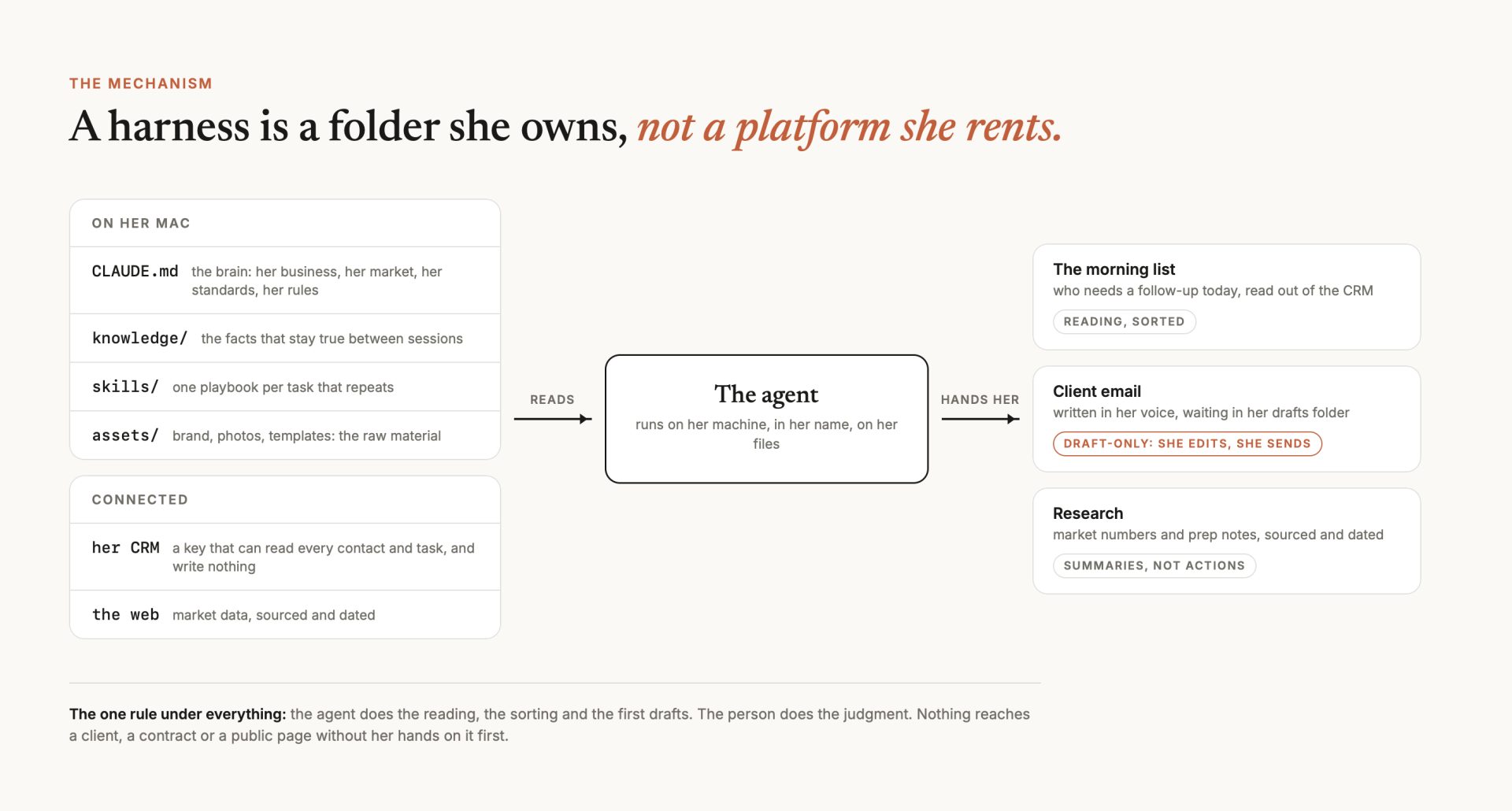
No platform. No subscription. No new tab. The harness is a folder of plain files on her own computer, and an AI agent (Claude, in this case) that works inside it.
The brain of it is one file that reads like an employee handbook written for someone with perfect recall: who she is, how her market works, what her standards are, and the rules that never bend. Beside it sits a knowledge folder for the facts that stay true between sessions, a skills folder holding one playbook for each task that repeats, and her actual working assets: brand files, photos, templates.

The folder matters more than the model. A person who leaves this arrangement keeps every file: the voice notes, the playbooks, the accumulated knowledge of their own business. Swap the agent underneath and nothing is lost. That is the opposite of how most business software treats a customer, and it is the reason a busy person can trust the setup enough to actually use it.
The permission ladder
The part that took real thought was not what the agent can do. It was what it cannot.
Her CRM is connected through a key that reads everything and writes nothing. The agent can see every contact, every stage, every task, and it cannot so much as tick a checkbox. Client email gets drafted straight into her drafts folder, in her voice, where she edits and sends or deletes. And a short list of things are banned in writing, inside the harness itself: sending anything to a client, writing to the CRM, and any public content whatsoever. Her social presence stays hers, every word of it. That last one was her rule, and it was the right one.

One ordering rule saved the project, and I would give it to anyone building something similar: do not let the agent draft in a person's name until its files hold that person's real voice, taken from things they actually wrote. A dozen real sent emails beat any description of tone. A generic first draft in week one reads as spam to the one person who has to trust the system, and you do not get that first impression back.
What changed
Her mornings now start with a list instead of a login: who has gone quiet, what is due, which of yesterday's inquiries never got an answer, each item with the reasoning shown. The logistics emails wait in her drafts folder for a quick edit instead of a blank compose window. Market prep that used to eat an evening comes back as a memo with sources and dates.
None of it is dramatic, which is the point. The agent took the reading. She kept the judgment. The hours came back from exactly the column of the list they were supposed to come back from.
The recipe, for any business
Nothing here is specific to real estate. The same shape fits a clinic, a shop, a solo consultancy, anyone whose week is eaten by reading and re-typing.
- Observe the real workflow first. Build from what repeats, not from what a demo makes look impressive.
- Write the brain file before connecting anything. The business, the standards, the rules that never bend. Plain text, owned by the person.
- Connect data read-only. Reading is where the hours go, and reading is reversible.
- Route every output through a place the person already reviews. A drafts folder is the perfect airlock: nothing in it can embarrass anyone.
- Add one skill per repeated task, after the task has been done together at least once.
- Write the bans into the harness, not into a promise. What the agent must never do should be a rule it reads on every run.
I run my own studio on the same architecture, several rungs further up the ladder, and the harness that reads my texts earned each of those rungs the same way: one at a time, with the receipts visible. For a business that wants the recurring version of this (loops that watch a metric and act on a cadence), that is its own discipline with its own guardrails.
The realtor's harness has been running since mid-August. The file she opens most is not a report the agent wrote. It is the morning list, three to seven names long, each with one line on why. That list costs her ninety seconds to read. It used to be the first hour of her day.
Related