Insights
The agency that never sleeps: running a business on AI loops
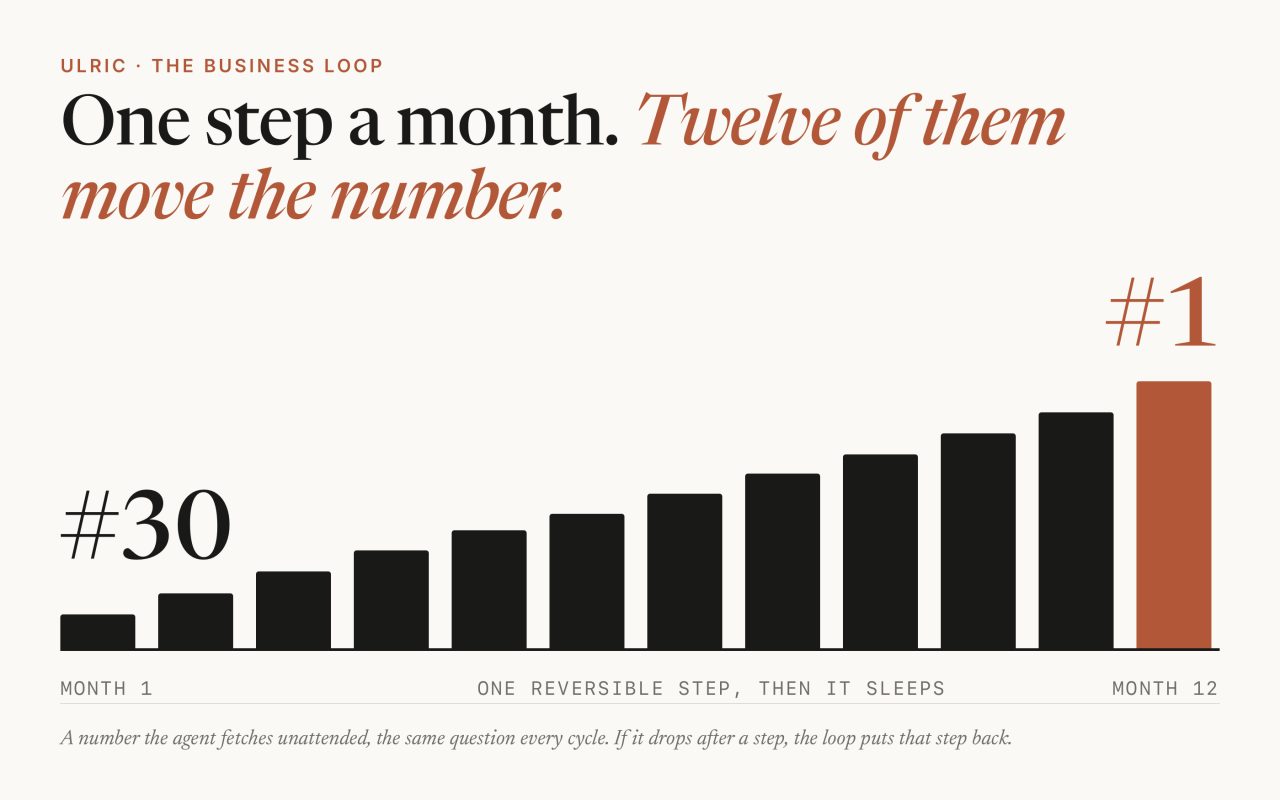
Almost everything written about AI loops is about building software. Give an agent a goal, a way to check its own work, and permission to keep trying until the code passes. It is a good idea, and it is not the interesting one.
The interesting one is using the same loop to run the business itself. Not to write the app, but to do the marketing, the ads, the search, the quality control, month after month, while you sleep. That idea barely gets talked about, and it is the bigger of the two.
What a loop actually is
Strip away the jargon and a loop is three things: a goal, a scoreboard that tells you honestly whether you are closer to it, and permission to keep taking one small step at a time until the scoreboard says stop.
Take a step. Check the number. Better or worse? Keep what worked, undo what did not, sleep, wake up, take another step. That is the whole shape.
This is not new theory. It is the pattern Andrej Karpathy calls the generation and verification loop: the machine generates, something cheap and reliable verifies, and you keep cycling. What is new is running it on a slow clock. The loop used to finish in thirty minutes. Now it takes a step, sleeps, and wakes up next month to take another one.
Four loops that run a business
The same shape, pointed at four different scoreboards. These are not hypotheticals. Each one is running somewhere in production right now.
The SEO loop. You sit at position thirty for a term you want to own. The loop runs once a month, makes one improvement, checks where you rank, and keeps pushing until you are on page one. The team behind the open-source app Inbox Zero has described running exactly this in production. It matters more than it used to, because fewer than a third of Google searches now send a click, so the loop has to watch real visits and bookings, not just the ranking number.
The ads loop. You are spending a hundred dollars a day and losing money. The loop tests new creative, checks profitability, kills what fails, and keeps going until the account is in the black. Ads are the most honest scoreboard there is: money in, money out, measured hourly.
The eval loop. Your AI feature is right eighty-eight percent of the time, and you need ninety. The loop adjusts the prompt, swaps the model, re-runs a fixed set of test questions, and only ships a change that moves the number up. This is test-driven development for AI: write the exam first, then keep working until you pass it.
The AI-visibility loop. People search in ChatGPT now, not only Google. Same loop, new scoreboard: when someone asks the assistant about your kind of business, are you the answer or not? Being cited in an AI answer is not the same as ranking on Google, and a Princeton study found that adding real citations and statistics to a page can lift how often an AI names it by thirty to forty percent.
The whole thing hinges on one number
Everything above depends on a single quality: a scoreboard that comes back black and white, without a person having to interpret it. Where do we rank. Did it clear profitability. Did the evals pass. Are we the cited answer.
Give an agent a number like that, one it can check by itself and compare month to month, and it can run for a very long time. Take away the honest number and you do not have a loop, you have a report that needs a human every cycle. If I could give you one test before automating anything, it is this: can the agent fetch the number unattended, is it the same question every time, and is "better" obvious. Three yeses, and you can build something that runs for a year.
Why this works now, when it did not two years ago
Loops used to run for thirty minutes because that was as long as an agent could stay useful before it wandered. That ceiling is lifting fast. METR measured that the length of task an AI can finish on its own has been doubling roughly every seven months for six years running. The practical upshot: a step that has to be small and supervised today can be longer and more independent by next quarter, and the loop around it keeps working the whole time.
The catch, said plainly
An agent that optimizes a real number, unattended, with your money and your name, can do real damage if you skip the guardrails. So I never ship a business loop without four of them.
- It undoes its own mistakes. If the scoreboard drops after a change, the loop rolls that change back before trying anything else. A loop that only pushes forward compounds errors. A loop that reverts on a bad number is the one you can trust to run alone.
- A human gate on anything you cannot take back. Spending money, publishing a page, emailing real people, deleting things. The loop proposes, a person approves. The strongest setups keep a human in exactly these spots and nowhere else.
- Hard limits in code, not in good intentions. A daily spend cap and a change budget the agent physically cannot exceed.
- A second, harder number. Rank can climb while bookings fall. So the loop watches a truer metric underneath, real customers, not just clicks, so it cannot win the scoreboard while losing the business.
How I use this at Ulric
This is not a thought experiment for me. It is how the studio works, and increasingly what it sells.
My growth line is these loops, productized. When a client hires me to grow an existing site, they are really hiring a monthly SEO loop and an AI-visibility loop pointed at their Business Profile and their pages. The plain-English scorecard they get each month, map views, calls, reviews, which AI queries name them, is the loop's scoreboard with the jargon removed. When their ads turn on, an ads loop runs them against real bookings, not vanity clicks. And behind any assistant I build, my product Pippin, there is an eval loop making sure its answers only ever get more accurate, never less.
I run the same loops on my own site before I sell them, which is the honest version of the pitch: I am not renting you a tactic, I am running you the machine I run on myself. You are, in effect, hiring an agency that never sleeps, gets paid in tokens instead of invoices, and quietly undoes its own mistakes the moment the number goes the wrong way.
That is the part worth sitting with. The tools to do this exist today. The businesses that win the next few years will not be the ones with the cleverest one-off campaigns. They will be the ones that turned their slow, boring, important numbers into loops, and let them run.
Sources. Andrej Karpathy, Software 3.0 (the generation and verification loop). METR, Measuring AI Ability to Complete Long Tasks (task length doubling every ~7 months). SparkToro, less than a third of searches send a click. Ahrefs, AI Overviews reduce clicks by 58%. Braintrust, eval-driven development. Aggarwal et al., Princeton, GEO: Generative Engine Optimization. Search Engine Land, what GEO is. Inbox Zero, getinboxzero.com. The framing owes a debt to the Startup Ideas Podcast, where the idea of loops to run a business, not just build one, gets its clearest airing.
Common questions
What is an AI business loop?
A loop is a goal, a scoreboard the agent can check by itself, and permission to keep taking one reversible step at a time until the number hits the goal. Run on a slow clock, it can improve a business metric like search rank or ad profitability for months, taking a step, sleeping, and stepping again.
What makes a business loop safe to run unattended?
Four guardrails: the loop reverts any change that makes the number worse, a human approves anything irreversible or outward-facing like spending money or publishing, hard budgets are enforced in code, and the loop watches a second harder-to-fake metric so it cannot win the scoreboard while losing the business.
What kinds of business tasks can run as a loop?
Any outcome with an honest, repeatable number: search rank (aim for page one), ad profitability (get into the black), AI feature accuracy (pass an eval threshold), and AI-answer visibility (become the cited answer). The common requirement is a scoreboard an agent can fetch unattended and compare over time.
Related