Insights
Grok Bot, and the question every small business now has to answer
For about a week my saved posts were all the same shape. An army of agents. Set it up correctly and you gain superpowers. A CEO bot directing worker bots while you sleep. Underneath the breathlessness sat something real: on August 11 xAI, now SpaceXAI, launched Grok Bot in beta, and the pitch went past the chat window entirely: AI teammates you can give real work to, each one with a computer of its own in the cloud.
What actually shipped
Strip the hype and the mechanism is clean. A Bot gets a persistent cloud machine with a browser, a filesystem and a terminal. It signs into the tools you already use, the way you do, which means it also works with the platforms that never bothered to ship an API. It keeps going with your laptop shut, and it comes back when something needs your approval. xAI says its own teams put Bots on sales outbound, marketing campaigns, office operations, bug fixes, recruiting and expenses before releasing it.
Access rides on the top subscription tiers: SuperGrok Heavy at $300 a month, Cursor Ultra at $200, or Cursor Teams Premium at $120 per seat. There is no free tier, which by itself tells you who the beta is for.
Two details from the third-party setup guides are worth more than the feature list. Connectors are installed account-wide rather than per bot, and the documentation warns against treating separate Bots as a security boundary. Deleting a Bot does not necessarily clear the shared machine's files or its logged-in browser sessions. None of that is a scandal. It is an architecture, and it is one to understand before you hand it a password.
The part the excited posts skip
A bot that signs into your accounts holds your access, not a scoped key you can revoke from a settings page. You are still typing the passwords and the two-factor codes yourself, into a browser running on someone else's computer, and what is left behind after you delete the bot is a question you have to go read the docs to answer. For a business where the CRM is the business, that is the whole conversation.
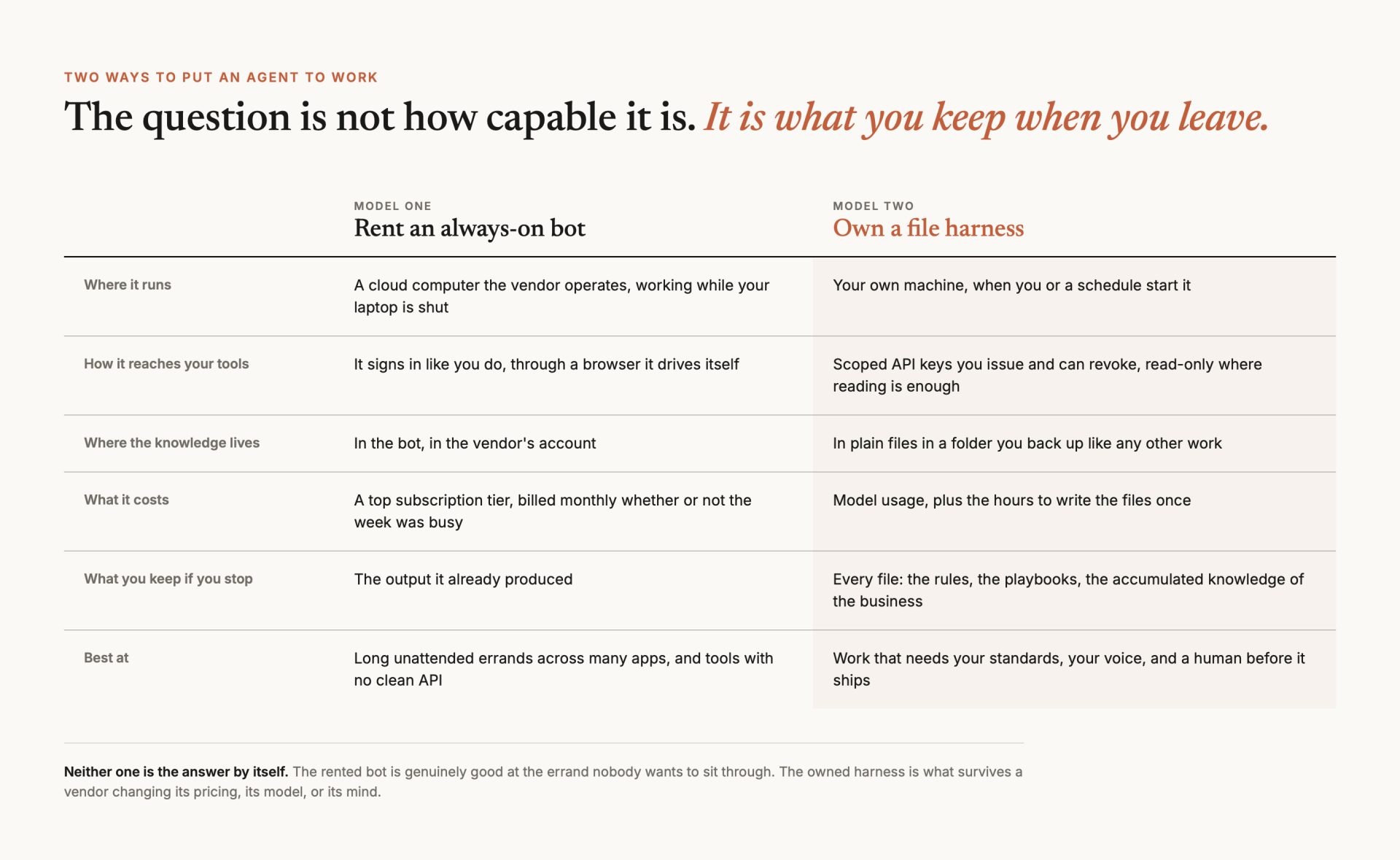
The table at the top of this page is the whole comparison. I build the second column for clients, so read the table with that bias in mind. But I am not arguing the first column is wrong. An always-on cloud bot doing a two-hour errand across four portals is genuinely useful, and the local harness I build is bad at exactly that job: it wants my machine awake and my attention nearby.
Sort the work first
Every business that asks me about this starts by asking which tool to buy. The better first move costs nothing: watch a week of your own work and put every task in one of three piles.

Pile one is what the rented bot is for. Pile two is what a harness of your own files is for, because a first draft in your voice requires your standards to be written down somewhere the model can read. Pile three is not a tooling problem at all, and the fastest way to make a business sound like every other business is to let something else write pile three.
Most people I talk to have a pile one that is smaller than they think and a pile two that is much larger. That ratio, not the feature list, is what should decide whether $300 a month is a bargain or a subscription to something you will use twice.
What I actually changed
Nothing, for clients. The realtor harness I set up this month still runs on her Mac with a read-only key into her CRM and drafts that land in her drafts folder, because everything valuable about it is the files, not the runtime. If a hosted bot becomes the better engine for pile one work later, those same files are what I would hand it. That is the entire argument for owning them.
For the studio, I am watching one thing: whether the always-on model gets a real permission system, scoped credentials, per-bot isolation, an audit trail you can hand an accountant. The moment that lands, pile one becomes worth renting for a lot of small businesses, and the harness quietly becomes the thing that tells the rented bot what good looks like.
The rest of that week's saved posts followed the pattern these waves always follow. One promised a free replacement for a paid coding plan if you install a stranger's repo and hand it your agent, which is a credential-harvesting shape old enough to have grandchildren. Another was a genuinely useful video-pipeline breakdown built on a five-file structure with a quality gate that rejects a quarter of what it makes. Same week, same feed, and the difference between them is whether anyone shows you the mechanism.
Related