Insights
Which AI video model should a small studio use in 2026
OpenAI is removing Sora from its API on 24 September 2026. The notice went out on 24 March and the deprecations page lists no replacement, which is an odd thing to read about the product that made this whole category loud. So I spent a day re-pricing the field off vendor rate cards instead of blog posts, because when the leader walks out the shortlist moves. This is where AI video models for a small studio stand in September 2026, with a price on each one I can point at.
What actually changed since spring?
Three things, and each moves a decision rather than a headline.
The first is the exit. OpenAI's deprecations page is unusually plain:
On March 24th, 2026, we notified developers using the Videos API and Sora 2 video generation model aliases and snapshots of their deprecation and removal from the API on September 24, 2026.
Nothing is listed as a recommended replacement beside sora-2, sora-2-pro or the Videos API itself. Any pipeline that calls them has a dated wall in front of it.
The second is that Google now sells two video paths at prices four times apart. On the Gemini API pricing page (updated 4 September 2026), Veo 3.1 standard is $0.40 per second at 720p and 1080p. Gemini Omni Flash bills video as output tokens at $17.50 per million, which the same page converts for you: 5,792 tokens per second of 720p video, "equates to an effective price of approximately $0.10 per second." Same vendor, same billing account, quarter of the price. There is no Veo 4 on that page.
The third is the one most likely to catch you out from a summary. Wan 3.0 sits at the top of the text-to-video arena and a lot of writing about it implies you can download it. You cannot. fal's own Wan 3.0 page says so: "Alibaba's published Wan weights currently stop at Wan 2.2 under Apache 2.0, and the releases since then have been commercial API models." There is no Wan 3.0 checkpoint under Alibaba's Hugging Face organisation. Open weights and open leaderboards are two different sentences now.
What does five seconds of video cost?
Between forty cents and two dollars for the models I could price directly. Every figure below came off the vendor's own rate card on 5 September 2026, converted to one unit: five seconds of output at the resolution named. Where a vendor page carries no price, the cell is empty.
| Model | Priced from | Per 5 s | Arena I2V | Worth knowing |
|---|---|---|---|---|
| MiniMax H3-Max, 768P | MiniMax API | $0.40 | 1201 | Arena entry is fal's post-trained build |
| MiniMax H3, 768P | MiniMax API, Replicate | $0.40 | 1187 | Weights published; licence excludes the US |
| Gemini Omni Flash, 720p | Gemini API | $0.50 | 1180 | Billed as output tokens, not seconds |
| Wan 3.0, 720p | fal | $0.50 | 1175 | $1.00 at 1080p; weights closed |
| Kling 3.0 v3 Pro | fal | $0.56 / $0.84 | Audio off / on. Commercial use needs written permission | |
| Runway Gen-4.5 | Runway API | $0.60 | 12 credits per second at $0.01 a credit | |
| Grok Imagine 1.5, 720p | Runway API | $0.80 | 1110 | 16 credits per second at $0.01 a credit |
| Seedance 2.0, 720p | Runway API | $1.80 | 1191 | 36 credits per second; ranked build hosted elsewhere |
| Veo 3.1 standard | Gemini API | $2.00 | 1087 | Fast is $0.50, Lite $0.25, both at 720p |
| LTX-2.5, self-hosted | your own GPU | no API fee | Free commercially under $10M annual revenue | |
| Sora 2 | OpenAI | Removed from the API on 24 September 2026 |
Two notes on that table. Kling's price is the only one I would not act on, because its user policy (effective 21 April 2026) says at 4.6 that "without our written permission, you may not use, reproduce, distribute, and create derivative works of, and make modifications to, the Output for any commercial purposes," and 4.5 asks you to label the output interface with the Kling brand. Secondary write-ups claim a paid tier lifts that. The policy text does not say so, and handing a client a deliverable that has to carry another company's logo is a conversation I would rather not open.
Does the arena ranking tell you what to buy?
No. It tells you which single clip people prefer when they cannot see the label, which is narrower than it sounds and useful anyway.
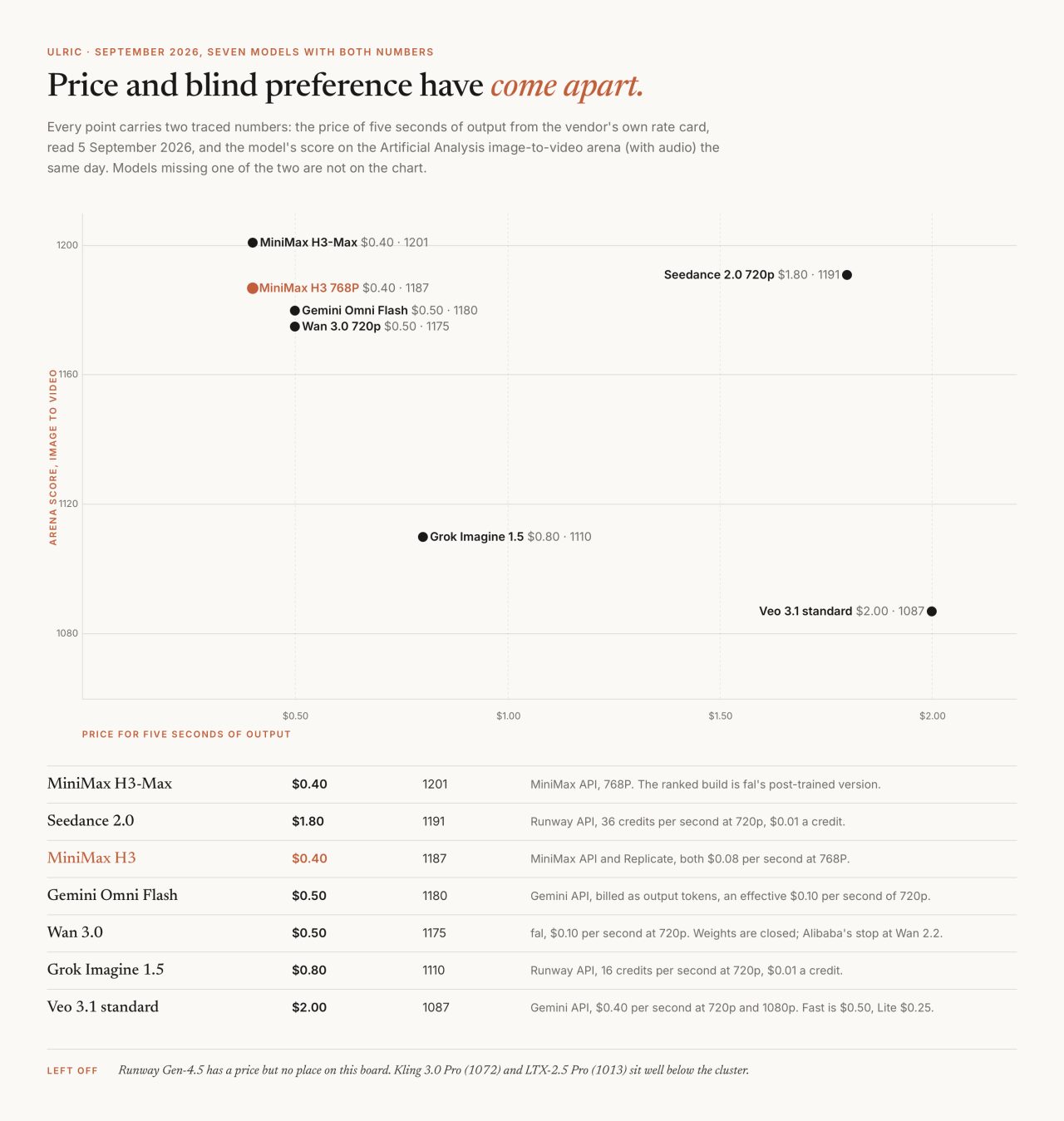
The Artificial Analysis image-to-video board, with audio, read on 5 September: MiniMax H3-Max on 1201, Seedance 2.0 at 1191, H3 at 1187, Gemini Omni Flash 1180, Wan 3.0 1175, and Veo 3.1 tenth on 1087. Put the prices beside the scores:

The two cheapest models on that chart rank first and third. The most expensive ranks last of the seven. Price and blind preference have come apart, and that is the most useful thing on this page.
Hold it loosely, though, because Elo here is a vote on one clip at a time. Curious Refuge's review of H3 (5 August 2026) found "texture instability, facial distortions, inconsistent compositing, and visual noise", and weaker multi-shot continuity than Seedance. Both are true at once: a single short clip is exactly where continuity failures never get a chance to show, and it is what the arena votes on. The studio rule for social video here is 5 to 30 seconds, hard ceiling 35, so my work sits inside the arena's blind spot more comfortably than a film would. That is luck, not vindication.
Which model for which job?
Pick by the job, before the run, not by the score. Six jobs cover almost everything a small studio ships:

The image-to-video row is the one I would spend money on first. H3 takes a first frame and a last frame, up to nine reference images, and generates native 32 kHz audio on every pass, which means a client's existing product photography is already the input. Five seconds of 768P is $0.40 on MiniMax's own API. The request shape is a task and a poll, not a stream:
curl -s -X POST https://api.minimax.io/v2/video_generation \
  -H "Authorization: Bearer $MINIMAX_API_KEY" \
  -H "Content-Type: application/json" \
  -d '{"model":"MiniMax-H3","resolution":"768P","duration":5,
       "content":[{"type":"text","text":"slow push in, warm window light"},
                  {"type":"image_url","role":"first_frame",
                   "url":"https://client-site.com/product-01.jpg"}]}'
# returns {"task_id": "..."}, then poll /v2/query/video_generation/{task_id}
# a moderation refusal arrives as HTTP 422, code 1026
That 422 is worth wiring for on day one. It is not a rate limit and it is not a 5xx, so a retry loop that only understands those two shapes fails quietly.
Can I generate video on the machine I already own?
Not for production, and I checked properly in August rather than guessing. This machine is a MacBookPro16,2 with Intel Iris Plus integrated graphics: no NVIDIA GPU for a CUDA container to bind to, which settled a different self-hosting question the same day.
The open-weight field is real, it just needs hardware. LTX-2.5 is a 22B model whose licence page grants commercial and production use at no cost under $10M in annual revenue, with a paid agreement above it. Wan 2.2 is the permissive alternative, Apache 2.0 with no revenue cap. HunyuanVideo 1.5 ships a bespoke Tencent licence rather than Apache, which matters more than its size does. MLX ports exist (mlx-video, rapid-mlx), but the hands-on reports I found are second-hand and brutal: one M1 Max at 64 GB spent 82 minutes on a two-second GGUF Wan 2.2 clip, and there is no first-party Apple Silicon benchmark for any of it. Local means look development. A rented GPU box is the honest version of self-hosting.
Is a video ladder the same as an LLM ladder?
Only in shape, and the difference is the interesting part. The chat cascade I run works because when the first rung fails, the second returns an answer of the same kind: slower, maybe blunter, still an answer. Video does not behave that way. A fallback that returns a different look has not recovered the job, it has produced a different shot, and nobody watching a client's reel cares that the first provider was down.
So a video ladder is a routing table chosen before the run, by job, not a runtime cascade. What does carry over is the discipline underneath it: collapse every failure shape into one path, record the model id and the resolution alongside the artifact, and check the artifact rather than the receipt. An async video API that hands back a task id and later a URL will happily report success for a file nobody has looked at.
What does the shortlist say about where AI is going?
The centre of gravity moved, and not toward the company that made this category loud. The models at or near the top of both arenas in September, Wan 3.0, MiniMax H3 and Seedance 2.0, are built by Chinese labs, though Google's Gemini Omni Flash ties Wan 3.0 for first on text-to-video and the top image-to-video entry is fal's post-trained build of H3. On Moonshots episode 284 a host framed it as "America is LLM-pilled and China is world-model-pilled": the language models predict the next token, the world models predict the next state of reality. It is a podcast framing, relayed rather than coined, and the exceptions are real. As a description of who is spending compute on pixels rather than tokens this year it is not far off.
The arena also measures the wrong thing for anyone who cares whether the water in the glass behaves. Google DeepMind's Physics-IQ benchmark films 66 real physical scenarios from three angles, two takes each, 396 videos in all, shows a model the start, and scores what it predicts against what happened, with 100 meaning realistic output that differs only in randomness. On 6 September 2026 the image-to-video scores on the revised Verified board read: Cosmos3-Super-Image2Video 42.7, MiniMax H3 39.8, Wan 2.2 32.2, Sora 2 26.5. The best entry on the whole board, a video-to-video system with a physics reward bolted on, reaches 58.2. So MiniMax H3, third in the arena and the cheapest model on the table, gets four in ten on how the world works, and the H3-Max build ranked above it does slightly worse at 36.2. For a studio that is a practical instruction rather than a philosophical one: choose shots where physics does not carry the story. A slow camera move over a product, a room, a face. Not pouring, not collisions, not cloth in wind, unless you are prepared to generate six and keep one.
The conclusion the ladder above reaches has also become conventional wisdom outside the trade. On All-In's 7 August episode a speaker, talking about media companies, said he would "use Gemini's model that does video ... or Sora or whatever the best model is for that particular application", and that "the idea that there's kind of a model that you pick for everything, I think is the false assumption" (All-In, from 16:42). That is the whole argument for pricing by job rather than by brand.
Where it goes next is out of a video model's reach altogether. The step after a clip you watch is a space you move through, which is a world model, and the most interesting one of those was announced this week and cannot be bought. I wrote that up separately in World Labs Atlas: what a world model means for AI and physics, including what the same physics benchmark implies for it.
What I would test first
Four experiments, in the order I would run them, and one thing not to bother with yet.
Price a real month before choosing anything. Twenty clips at 15 seconds is 300 seconds of output. On Gemini Omni Flash that is $30.00, on MiniMax H3 at 768P $24.00, on Veo 3.1 standard $120.00. The arithmetic takes a minute and settles more than a week of demo reels does.
Feed it photography that already exists. Most clients have been shot properly at least once. At $0.40 for five seconds you can run one still through three models in an afternoon, and the thing to judge is whether the subject is still the same object at second four. Identity drift is the reported failure, so go looking for it.
Put the clip in the page, not just in a feed. A five-second generation is exactly the length that scrubs well against scroll, where the viewer controls the timeline and a wobble in frame 40 never gets a chance to be a wobble.
Decide the disclosure before you generate. The EU AI Act's transparency obligations took effect on 2 August 2026, requiring machine-readable marking of synthetic media. Google made the visible watermark optional on 14 August 2026, but SynthID and C2PA metadata stay embedded regardless: assume every commercial model's output is machine-detectable whatever the toggle says. Industry reporting says Meta added a mandatory AI-disclosure control to its ad tools in March 2026, which I could not find on Meta's own advertising standards page, so treat it as likely and unconfirmed. If the output goes near a property listing, check the MLS's rules on altered or generated images first.
One licence trap in the same breath: MiniMax published H3's weights, but the grant covers only an "Applicable Territory" that explicitly excludes the European Union, the United Kingdom, the Republic of Korea and the United States of America. A US business has no licence to self-host them. The hosted API is a separate agreement and is fine. That distinction is invisible from a download button.
The thing not to bother with yet is asking a video model for a place. If what you want is a room a visitor can move through rather than a shot they watch, that is a world model, not a video model, and the most interesting one is announced rather than purchasable. The alternative that ships today is still geometry you build yourself.
One number stayed out of reach. fal lists per-second pricing on its individual H3 model pages, and my notes record a promotional H3-Max rate expiring on 7 September, but fal's own pricing page today itemises Wan 2.5, Kling 2.5 Turbo Pro, Veo 3 and Ovi and sends MiniMax pricing back to the model page. So every MiniMax figure above is MiniMax's own or Replicate's. I will look again on the eighth, when the promotion is supposed to be over.
Common questions
What is the cheapest top-ranked AI video model with a published price in September 2026?
Of the models I could price off a vendor page, MiniMax H3 at 768P is the cheapest capable option: $0.08 per second on MiniMax's own API and on Replicate, so $0.40 for a five-second clip. Gemini Omni Flash is next at an effective $0.10 per second of 720p, which Google states on its pricing page. Veo 3.1 standard is $0.40 per second, five times H3, and ranks tenth on the image-to-video arena where H3 ranks third.
Is Sora still available through the OpenAI API?
Not after 24 September 2026. OpenAI notified developers on 24 March 2026 that the Videos API, sora-2 and sora-2-pro would be removed on that date, and the deprecations page lists no recommended replacement. Anything calling those model ids needs a different provider before then.
Can a US business self-host MiniMax H3 open weights?
No. The published licence grants rights only in an Applicable Territory defined as worldwide excluding the European Union, the United Kingdom, the Republic of Korea and the United States of America. Self-hosting the weights from a US business is outside the grant. Using the hosted API through MiniMax, fal or Replicate is a separate agreement and is available commercially.
Can Kling output be used commercially?
Not without written permission, according to the user policy effective 21 April 2026. Section 4.6 says that without Kuaishou's written permission you may not use, reproduce, distribute or make derivative works of the output for any commercial purposes, and 4.5 asks you to label the output with the Kling brand. Secondary sources claim paid tiers lift the restriction; the policy text does not say that, so get it in writing before a client deliverable depends on it.
Can you generate AI video locally on a Mac?
For experimentation, not production. MLX ports (mlx-video, rapid-mlx) run LTX-2.5 and Wan 2.2 on Apple Silicon, but there is no first-party benchmark and the hands-on reports are slow enough to rule it out for delivery: one M1 Max with 64 GB took 82 minutes for a two-second Wan 2.2 clip. A machine with Intel integrated graphics has no CUDA path at all. Rent a GPU box if self-hosting matters.
Related