Insights
The fine print on AI video in 2026: what the terms say
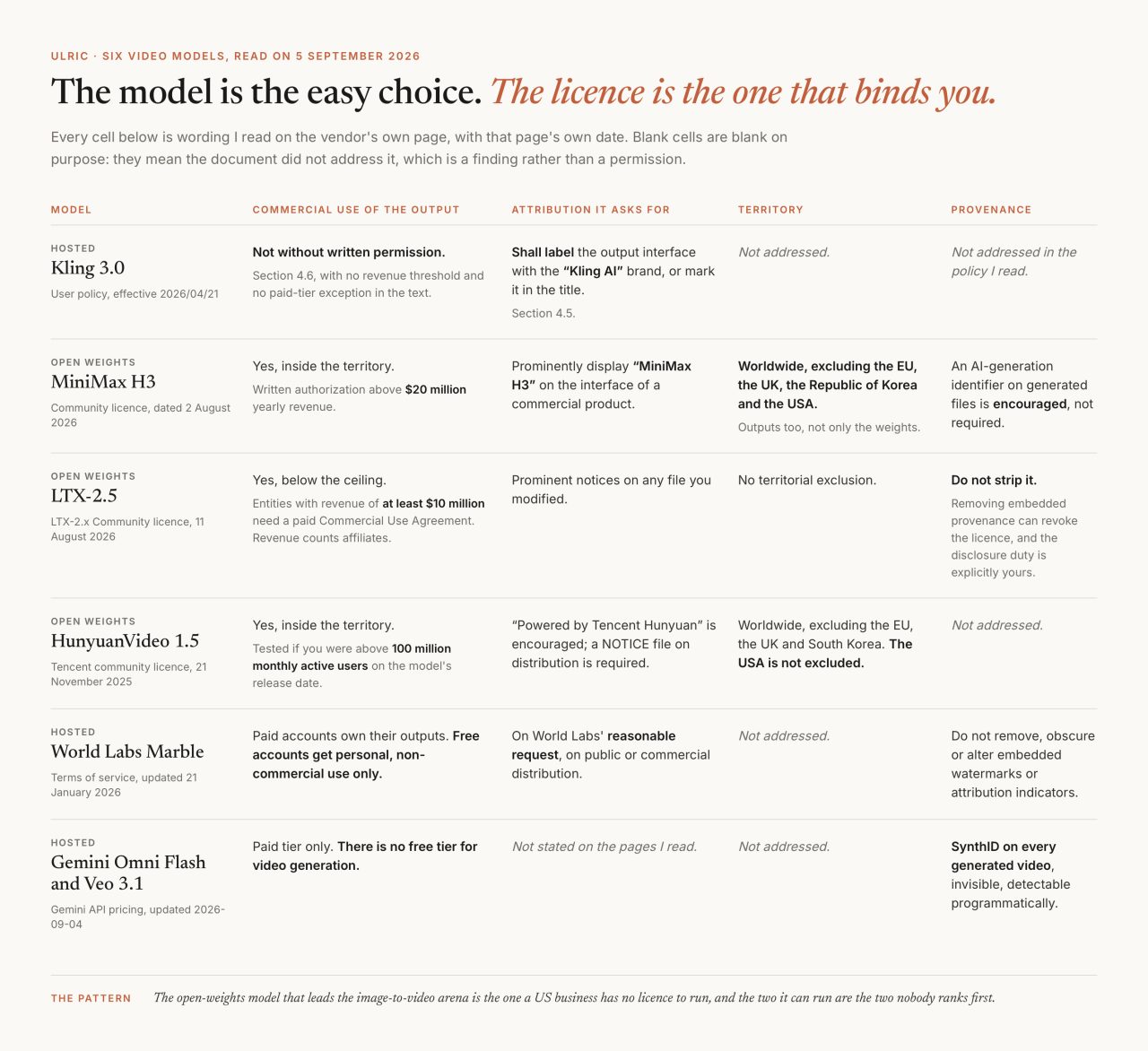
I sat down on 5 September to write a one-page checklist for generated video, the kind a studio runs before a clip goes near a client's feed. It turned into a day of reading licences. Every quotation below came off the rights holder's own page that day, with that page's own date attached, and I am not a lawyer: this is what the documents said, not advice about what they mean for you.
The interesting differences between AI video models in 2026 are not on the model card. Quality has converged enough that choosing between the top few is mostly taste and price, which is the model comparison's job. The ones that cost you something sit three pages deeper.
Can you use the clip commercially?
Less often than the pricing page implies. The sharpest case is Kling, whose user policy took effect on 21 April 2026 and says this in section 4.6:
Specifically, without our written permission, you may not use, reproduce, distribute, and create derivative works of, and make modifications to, the Output for any commercial purposes.
No revenue threshold, no paid-tier exception anywhere in the text I read. Section 4.5 requires you to label the output interface with the "Kling AI" brand or mark it "in the title or other prominent positions". Meanwhile fal's Kling v3 Pro listing, where most people reach the model, carries a badge reading "Commercial use" beside $0.112 per second with audio off. That badge is a marketplace describing its own tier. It is not a grant from Kuaishou.
The other hosted services draw the line at the paywall instead, which is easier to plan around. World Labs, terms updated 21 January 2026, licenses free accounts "solely for personal, Non-Commercial Use", gives paid accounts ownership, and asks them, "upon World Labs' reasonable request", to attribute World Labs on public or commercial distribution. Google sidesteps the question: its pricing page, updated 2026-09-04, lists the free tier for Gemini Omni Flash and Veo 3.1 as "Not available".

Which open weights can a US business actually run?
Not the one at the top of the board. The Artificial Analysis arena says "MiniMax H3 currently leads among open weights Image to Video models with audio", and H3's weights are published. Then you open the licence, dated 2 August 2026, and read definition 5:
"Excluded Territories" means the European Union, the United Kingdom, the Republic of Korea and the United States of America.
Rights are granted "solely within the Applicable Territory", and section V.4 reaches past the weights to the results: "You may not use, reproduce, modify, distribute, or display the MiniMax H3 Works or any of their Outputs or results outside the Applicable Territory." A US business has no licence to run those weights on its own hardware. MiniMax says so plainly rather than burying it, and invites anyone in an excluded territory to "contact us about obtaining a license". Hosted API access is governed separately by that service's terms, the path the H3 post takes.
Tencent's licence for HunyuanVideo 1.5 has the identical shape and a different list: "Territory" means worldwide "excluding the territory of the European Union, United Kingdom and South Korea". The United States is not on it. Same clause, opposite answer for a US studio, tested if you were above 100 million monthly active users on the model's release date instead of a revenue figure.
LTX-2.5, licence dated 11 August 2026, takes a third road: no territory carve-out, a revenue floor instead. The model card says "Over $10M annual revenue" needs a paid agreement; the binding text is stricter by a hair, catching entities "with annual revenues of at least $10,000,000", counted across "all subsidiaries, affiliates, and other companies under common Control".
What happens when you switch the watermark off?
The picture changes. The provenance does not.
Since August 2026 Google has made the visible watermark optional on content from Nano Banana, Omni and Lyria. TechRepublic reported it on 17 August, quoting Google VP Josh Woodward: "while the visible watermarks are now optional, invisible SynthID watermarks and C2PA metadata are still being used for transparency." The developer docs put it flatly. Google's page for Gemini Omni Flash: "All generated videos include SynthID watermarking, which is invisible to viewers but can be detected programmatically for provenance verification." DeepMind adds the part that matters in a pipeline: the mark is "designed to stand up to modifications like cropping, adding filters, changing frame rates, or lossy compression".

The third row is the one to internalise. C2PA Content Credentials live in the file's metadata, and metadata dies first: a screenshot kills it, so does a re-encode that does not deliberately carry it, so does a platform that rewrites the container on upload. The pixel-level mark survives all three, and has no switch.
Which leads to a clause I did not expect in an open-weights licence. LTX's agreement says you "shall not remove, disable, alter, or circumvent, any safety or security measures, disclosures, metadata, watermarking, content provenance, latent disclosure, or other transparency features", and that if Lightricks believes you modified the model so it can no longer carry them it "may in its sole discretion revoke the license". Self-hosting does not put you outside the provenance regime. It moves the duty onto you.
What do you hand back over your prompts and your client's footage?
Something, on every service I read. The amounts are not remotely alike.
| Service | What you grant over inputs and outputs | For how long | Can you take it back |
|---|---|---|---|
| Hailuo (MiniMax web) | Licence to use, modify, distribute and "derive revenue or other remuneration from" your content | Perpetual and irrevocable | No. It survives termination "by any party, for any reason" |
| Kling AI | Licence over Input and Output: host, store, reproduce, modify, distribute | "During the operational period of its business" | Yes, by emailing [email protected] (4.7.4) |
| World Labs | Sublicensable licence to use and analyse User Content, including model training | Free: irrevocable. Paid: revocable | Paid accounts only, and only going forward |
| Gemini API | A pricing-table row headed "Used to improve our products" | Not stated on the pricing page | By choosing the paid tier, where the answer is No |
The Hailuo wording is the one to sit with, because the input to an image-to-video job is usually a client's product photography or somebody's face. MiniMax does not claim ownership. What you grant it, in the version last modified 08/19/2026, is a "royalty-free, perpetual, irrevocable, worldwide, non-exclusive right (including any moral rights) and license" that "survives termination of this Agreement by any party, for any reason".
World Labs is the most explicit about what revocation buys: paid users can opt out of training, but "Revocation applies prospectively and does not require removal of User Content from AI Models already trained prior to revocation." Google's version is a table row. Under every model on the pricing page sits a line reading "Used to improve our products": Yes on the free tier, No on the paid one. That row is the whole data-handling decision for text; for video the paid tier is the only tier.
What does the law require as of 2 August 2026?
Two things, aimed at two different parties. Article 50(2) of the EU AI Act puts the marking duty on the provider, whose outputs must be "marked in a machine-readable format and detectable as artificially generated or manipulated". Article 50(4) puts a disclosure duty on the deployer, which is the studio or the client rather than the model maker: "Deployers of an AI system that generates or manipulates image, audio or video content constituting a deep fake, shall disclose that the content has been artificially generated or manipulated." Article 113 supplies the date: "It shall apply from 2 August 2026."
Then there is Meta, where the version everyone repeats is one I could not verify. Industry reporting says Meta added a mandatory AI-disclosure control to its ad policies in March 2026, covering ads in general. I opened Meta's Introduction to the Advertising Standards on 5 September 2026, rendered in a real browser, and the strings "AI-generated", "generative AI" and "artificial intelligence" appear zero times on it. That claim is unverified against a primary Meta source, and I am not going to pass it on as fact.
What Meta's pages do say is narrower. On the standard for ads about social issues, elections or politics, advertisers "must also disclose when a social issue, elections, or political ad contains a photorealistic image or video, or realistic sounding audio, that was created or edited using third-party generative AI tools" in three listed deepfake-style situations, and undisclosed ads are rejected. The same page adds that "beginning June 1, 2026, Meta will also use automated detection technology to identify when ad media has been created or edited using third-party generative AI tools", after which an "AI Info" label appears with no advertiser action required. For an ordinary commercial ad the checkbox is not documented. The label is.
What happens when a model is simply withdrawn?
It goes, and the replacement column stays empty. From OpenAI's deprecations page:
On March 24th, 2026, we notified developers using the Videos API and Sora 2 video generation model aliases and snapshots of their deprecation and removal from the API on September 24, 2026.
Six rows follow, the Videos API plus sora-2, sora-2-pro and three dated snapshots, all shutting down on 2026-09-24, and every "Recommended replacement" cell reads ---. That is this month. A video model is a dependency with an expiry date, which is the reasoning behind the fallback chain in the model ladder post. The consequence is cheap: keep the prompt, the reference stills and the settings, not just the render. An mp4 on a client's server is not portable to the next model. A folder holding its inputs is.
A pre-flight check before a generated clip ships
Eight questions, only the first four about the model.
- Is commercial use granted by whoever owns the model, not by the marketplace reselling it?
- Does it require a visible credit, and where: the video, the page, or the product's interface?
- If the weights are self-hosted, is this business inside the licence's territory and under its ceiling?
- What did the client's uploaded media get licensed for, and does that survive closing the account?
- Is the clip a deep fake under Article 50(4), and if so, where does the disclosure live?
- Has anything in the pipeline stripped the provenance data, and was that deliberate?
- If the model is withdrawn in six months, what still exists that lets this be remade?
- For a property page fed by an MLS, what do the local board's rules say about altered or generated images?
The cheapest way to answer most of them is a small JSON file written beside the clip as it is generated, not assembled later by whoever is left on the project:
{
  "clip": "clips/2026-09-10-hero-05.mp4",
  "model": "gemini-omni-1.1-flash",
  "read_terms_on": "2026-09-05",
  "commercial_use": "paid tier, vendor pricing page",
  "credit_required": null,
  "provenance": ["synthid-embedded", "c2pa-manifest-present"],
  "inputs": ["stills/product-03.jpg", "prompts/hero-05.txt"],
  "disclosed_as_ai": true
}
Written by the same script that calls the API, it outlives whoever made the clip. My rule that every social clip runs 5 to 30 seconds turns one shoot into a numbered series, so there are far more sidecars than you would guess, which is the argument for generating them rather than typing them. Same instinct as the files that keep AI slop out: put the rule where the machine has to read it.
The one worth testing before anything ships is the sixth. Push a finished clip through your real publishing path, upload, transcode, CDN, then check on the far side whether the C2PA manifest survived, because that answer belongs to your stack and nothing else. The eighth is the one no licence answers, which is the same reason the world-model post keeps returning to its attribution clause.
The one cell I could not fill is Kling's. Its Terms of Paid Service is the document that would settle whether a paid plan lifts section 4.6, and the route serving it returns the site's shell to anything that is not a full browser. I loaded it in a real Chromium, waited for the network to go quiet, and read back 130 characters: seven navigation links, no document. Whatever it says, I still cannot quote a word of it.
Common questions
Can you use AI video output commercially?
It depends on the model, and not always the way the pricing page implies. Kling's user policy, effective 21 April 2026, says in section 4.6 that "without our written permission, you may not use, reproduce, distribute, and create derivative works of, and make modifications to, the Output for any commercial purposes", with no revenue threshold and no paid-tier exception in the text. World Labs restricts free accounts to personal, non-commercial use and gives paid accounts ownership. Google has no free tier for video generation at all. A "Commercial use" badge on a marketplace that resells a model is that marketplace describing its own tier, not the rights holder granting a right.
Can a US company self-host MiniMax H3?
Not under the published licence. The MiniMax H3 Community License Agreement dated 2 August 2026 grants rights "solely within the Applicable Territory", and defines "Excluded Territories" as "the European Union, the United Kingdom, the Republic of Korea and the United States of America". Section V.4 extends that to outputs as well as weights. MiniMax invites anyone in an excluded territory to contact it about obtaining a licence. Hosted access through an API is governed separately by that service's own terms.
Does turning off the visible watermark remove SynthID?
No. Google made the visible watermark optional in August 2026 for content made with Nano Banana, Omni and Lyria, but the developer documentation for Gemini Omni Flash still states that "All generated videos include SynthID watermarking, which is invisible to viewers but can be detected programmatically for provenance verification". The fragile layer is C2PA Content Credentials, which live in the file's metadata and are lost to a screenshot, a re-encode that drops metadata, or a platform that rewrites the container on upload.
What does the EU AI Act require for AI video from August 2026?
Article 50(2) requires providers of systems generating synthetic video to ensure outputs are "marked in a machine-readable format and detectable as artificially generated or manipulated". Article 50(4) requires deployers of a deep fake to "disclose that the content has been artificially generated or manipulated", with a reduced obligation where the content forms part of "an evidently artistic, creative, satirical, fictional or analogous work". Article 113 says of the Regulation: "It shall apply from 2 August 2026."
Does Meta require advertisers to disclose AI-generated content?
For ads about social issues, elections or politics, yes: Meta's own standard says advertisers "must also disclose when a social issue, elections, or political ad contains a photorealistic image or video, or realistic sounding audio, that was created or edited using third-party generative AI tools" in three listed deepfake-style situations, and undisclosed ads are rejected. The same page says that beginning 1 June 2026 Meta uses automated detection to apply an "AI Info" label with no advertiser action required. The widely repeated claim that Meta added a mandatory AI-disclosure control for ads generally in March 2026 is unverified: it does not appear on Meta's Introduction to the Advertising Standards as read on 5 September 2026.
Related