Light class
Petrel
620 kg to low orbit
Single stick, methane first stage, printed engines. Flies weekly, lands on the pad it left.
Loading flight
0%
A scroll lab demo
Launch services for a solar system that never was.
Scroll to fly
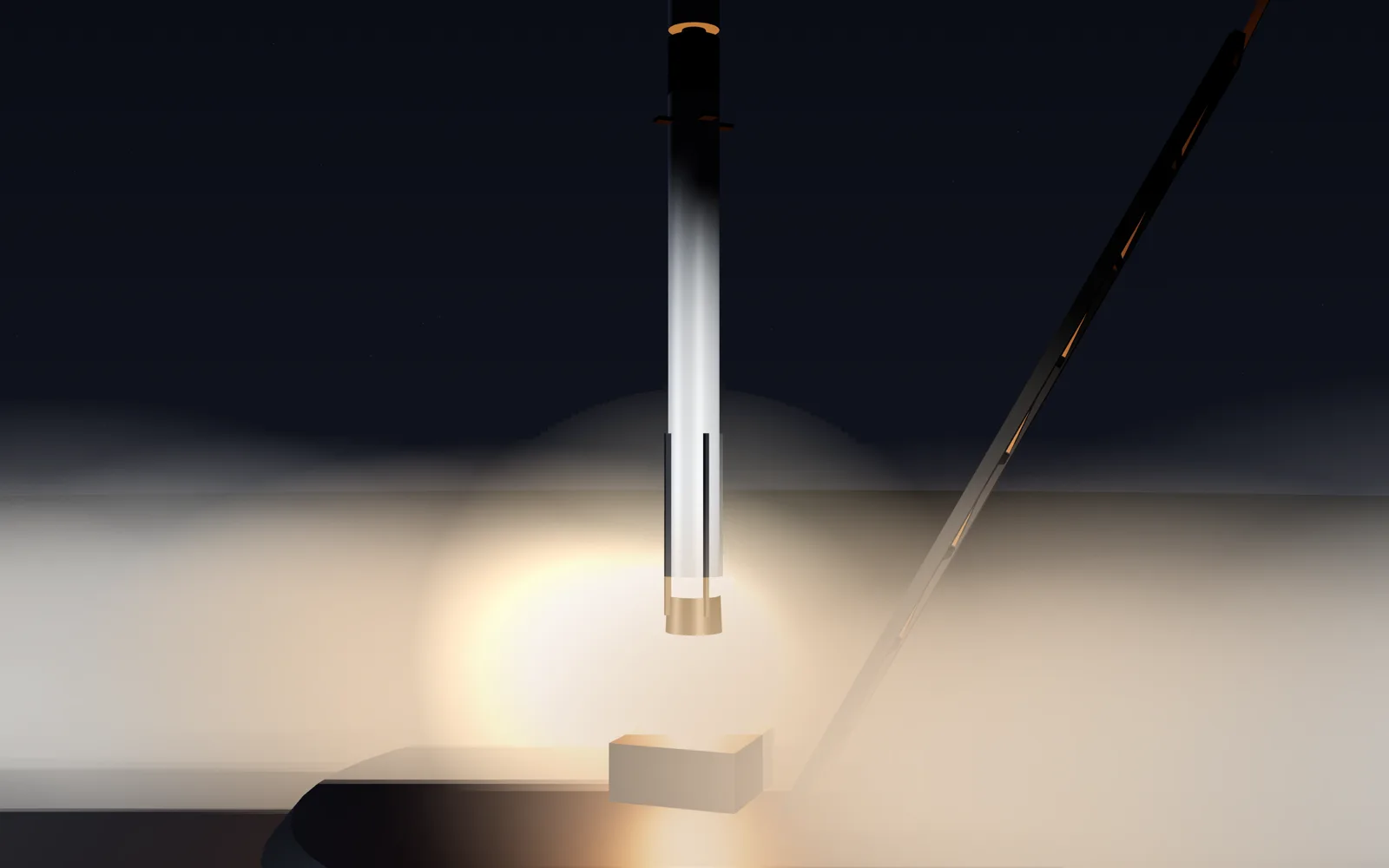
The live 3D version of this page needs a newer browser (Safari 16.4 or later, or a current Chrome or Firefox). Here is a still and the story in plain text.
T-00:00 · PAD
Frigate stands fueled under the floodlights, strongback easing away. Scroll starts the count.
T+01:12 · MAX Q
Steam stays with the pad, the booster does not. Nine engines, one gravity turn, every meter keyed to scroll.
T+02:38 · STAGING
Main engine cutoff, the booster falls home, and the second stage lights for orbit.
The fleet
Every number below is invented, like the company. The page is the product: three separate scroll films on one page, each with its own scrub.
Light class
620 kg to low orbit
Single stick, methane first stage, printed engines. Flies weekly, lands on the pad it left.
Medium class
4.2 t to low orbit · 1.1 t to transfer
The workhorse. Two stages, recoverable booster, fairing wide enough for a school bus.
Heavy class
18 t to low orbit · crew rated
Three cores at liftoff, one home by sunset. Carries the station modules the others resupply.
T+03:29 · FAIRING
Two halves swing away over a lit planet and fall behind. The payload sees space for the first time.
T+09:47 · DEPLOY
Panels unfold, the spring pushers fire, and the spacecraft flies its own mission from here.
Cadence
38
flights on last year's fictional manifest
72 h
pad turnaround between missions
3
launch sites, one on each invented coast
T+41:00 · SYSTEM
Pull back from a real-textured planet to the working system: six worlds, one sun, and the mission tracing its arc in orange.
The point
HALCYON ORBITAL
A fictional company, a real technique: three scroll-driven flight films on one page, night pad to planetary system, drawn live in the browser.
Planet textures by Solar System Scope, CC BY 4.0. Launch photography by SpaceX studied as reference; nothing here is theirs.